|
 By Nina de la Preugne By Nina de la Preugne
A year after the defeat of the separatist Liberation Tigers of Tamil Eelam (LTTE) and the end of the country’s 26-year civil war, Sri Lanka once again finds itself at a crossroads. The forthcoming parliamentary elections will set in stone the future of the country.
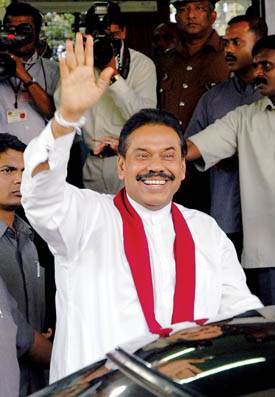
The re-election of the victorious war leader Mahinda Rajapaksa as president earlier this year has set the scene for his coalition to secure a parliamentary majority in tomorrow’s vote. The real question is whether Sri Lankans will give him the two-thirds majority he needs to change the constitution – and if they do, what those changes will be.
There is no doubt that Rajapaksa’s coalition, the United Freedom People Alliance (UFPA), will achieve a comfortable majority, allowing the president to form a strong government. In fact, in many constituencies the election is between different members of the UPFA, rather than between the government and the opposition.
Although achieving a two-thirds majority will still be difficult for the governing coalition, analysts say that Rajapaksa will be able to buy off independent and opposition MPs further down the line in order to achieve the necessary number of votes in parliament to amend the constitution.
The Rajapaksa government has been characterised in recent years by nepotism, corruption and the marginalising of minorities. Critics fear that placing more power in his hands does not augur well for the future of the island. “One of the main objectives will be to amend the constitution so that he can run for a third term, you can be sure of that,” a Sri Lankan journalist in Colombo told me yesterday.
The word ‘dynasty’ springs easily to mind. Rajapaksa’s family grip on political power has strengthened over the years. His brother, Gotabhaya Rajapaksa, is the defence minister, several of his family members have a seat in parliament, and now his son is standing for election as well. The legacy is set to continue.
At the bottom of his agenda – in fact, not on the agenda at all – is reconciliation with the country’s Tamil minority. Rajapaksa has made it clear there will be no concessions. The federal system advocated by Tamil politicians will be out of the question for the next six years.
During a recent trip to Jaffna, where he tried to pick up a few votes in the Tamil-dominated city, the president suffered a revealing slip of the tongue. He was booed for speaking in Tamil rather than the country’s native Sinhala by the largely Sinhalese crowd.
Rajapaksa, using a Sinhala insult, told the hecklers “Shut up you demala”; unfortunately, in Sinhala “demala” also means “Tamil”. The insult was meant at the Sinhalese, but the sentence “Shut up you Tamils” was rather unfortunate coming from the president, and seemed to reflect the government’s current state of mind. Getting Tamil votes? Yes we can! Taking Tamils seriously? Well…
Holding parliamentary elections so soon after cementing the presidency was a smartly calculated move by the government, allowing the ruling party to tap into the heroic status of its leader. The opposition, already weak and divided, is constantly intimidated and the recent arrest of Rajapaksa’s main opponent during the presidential election, the former army chief General Sarath Fonseka, is only the most blatant example.
General Fonseka was arrested for sedition and is now facing a number of trials before a court martial. Yesterday, a hearing was held in Colombo but was then pushed back to 9th April, according to the Agence France Presse newswire. Observers say the authorities are simply trying to keep him in custody for as long as possible until his support wears off. “It is working, there was already less of his supporters protesting today. People are fed up,” says a journalist.
Maureen, a 60-year-old Sinhalese woman, is indeed fed up: “I am tired of all this drama, whether it is the war or the politics. I will vote for the UPFA, some people criticise Rajapaksa but at least he ended the war.”
Outside, the night resonates with the sound of megaphones shouting campaign slogans like promoters announcing a new circus in town. But now there are no more Tigers to tame, what will the show deliver?
|

