|
 By Peer Muhammad By Peer Muhammad
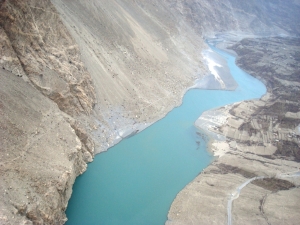
Almost 25,000 people in Pakistan’s lush green Hunza Valley have been stranded and cut off from the rest of the country for the last two and half months after a deadly landslide on January 4th blocked the Indus River and created a 12km artificial lake, submerging the main road out of the region.
The devastating landslide wrought havoc upon the village of Attabad, burying two dozens people under the debris. Since then, there has been no release of water from the river in the narrow valley, and 14km of the Karakoram Highway (KKH), which connects Pakistan and China, has been completely wiped out.
As a result, around 25,000 people living in almost 20 small villages along the KKH in the mountainous area of Gojal are unable to flee.
There is no alternative method of transportation to other parts of the country. The Pakistani government has recently arranged boats for serious patients and similar cases, but people’s everyday lives have been completely paralysed by the submergence of the main road link.
People’s misery has multiplied as the international border with China is also closed in the wake of heavy snowfall. The inhabitants are wholly reliant on the limited stock of daily commodities, dispatched by the government and some NGOs during the initial days after the incident.
Despite the efforts of the government and other agencies, it has still not been possible to breach the artificial lake created after the landslide which blocked the Indus, and the water level is rising almost two feet everyday.
As a precaution, a large number of villagers along the riverside were asked to evacuate the area in case the lake suddenly bursts. With each passing day, the area is submerging, posing a serious threat to both the upstream and downstream population. Most of the people in the affected areas are relying on small trade and farming, and have badly suffered from the disruption of transport and communication.
Three small villages are completely submerged, while business and livestock have been destroyed in the remaining villages. Social, political and economic activities in these villages have also been badly affected.
Experts warned at a high level meeting in Islamabad last Friday that the sudden burst of the lake could also be dangerous for the country’s second largest reservoir, the Turbella Dam, located in Harripur, NWFP, potentially affecting many people in that province.
Any sudden burst of the lake could sweep away a number of villages downstream, up to the provincial capital city, Gilgit. The wise approach would be for the authorities to take immediate measures to gradually release the accumulated water from the landslide-induced dam so as to decrease the pressure before the start of summer, when the melting glaciers would further increase the risk.
But even after more than two months, neither the federal government nor the local government in Gilgit-Baltistan has developed a mechanism to breach the dam to minimise the risk level. The authorities are also hesitant to seek any help from international rescue agencies. Meanwhile the lake is swelling alarmingly with each passing day.
The Chief Secretary of Gilgit-Baltistan, Babar Yaqoob, said that the local government was awaiting the assessment report of National Engineering Service Pakistan (NESPAK), and that rescue measures would be taken after its recommendations.
The Parliamentary Committee on Gilgit-Baltistan is not meeting to discuss the situation. Shahzada Mohiouddin, the Chairman of the National Assembly Parliamentary Committee on Gilgit-Baltistan, said that as his wife was in hospital, he could not convene the committee despite being well aware of the suffering in Hunza.
Meanwhile, the affected communities are extremely concerned at the slow response of the government, and have urged the international community to step forward to rescue them from a major disaster.
|

