
| The long war on stop and search |
|
| Politics and Policy |

In 2003, two people were stopped and searched outside London’s Excel Centre and prevented from attending a peaceful protest against the arms fair taking place inside. Journalist Pennie Quinton was forced to stop filming despite showing her press card, and Kevin Gillian was stopped for 20 minutes when riding his bike.
In the first of a two-part look at anti-terror stop and search laws, Tomas Mowlam reports on the six-year court battle and the flaws with the sweeping legislation.
“I was personally quite confident – I seemed to be the only one,” laughs Corinna Ferguson, Liberty’s legal officer on the case. “Logically when you’ve lost every attempt in the domestic courts then there’s not much grounds to be confident in the European Court, but we always said that the House of Lords judgment was wrong and took a particularly narrow view of the concept of privacy.”
If the ruling had simply found against the government then it would not have caused such a big stir, but the ruling was broad and heavily critical of the government. The court held that “the safeguards provided by domestic law have not been demonstrated to constitute a real curb on the wide powers afforded to the executive, so as to offer the individual adequate protection against arbitrary interference.”
The court added that “there is a clear risk of arbitrariness in the grant of such a broad discretion to the police officer.” Powers under Section 44 were “neither sufficiently circumscribed nor subject to adequate legal safeguards against abuse.”
Though couched in legal language it was a dressing down of the government over the sweeping powers granted to the police under Section 44.
Problems of scope and scale
The main problem was not necessarily even the concept of stop and search without suspicion, which even Liberty feels maybe necessary in certain extreme cases, but the sweeping way in which Section 44 was applied.
The 28 days for which an area could be covered under a Section 44 order – enabling police to stop and search people there without suspicion – became increasingly irrelevant as areas were simply re-designated to provide rolling coverage.
Through the litigation it also emerged that areas as large as Greater London were designated on the quiet.
The often intimidating nature of these stop and searches also meant that people rarely knew what power they were being stopped and searched under, and had little prospect of redress if they felt it was unfair.
The authorisation process for a Section 44 order is sketchy – oral consent can be given and then later confirmed in writing, and authorisation only has to come from a rank of Assistant Chief Constable or above.
Authorisation for Section 44 currently rests on the fact that it is “expedient for the prevention of acts of terrorism”. According to the ECtHR ruling however, “expedient means no more than ‘advantageous’ or ‘helpful’.
“There is no requirement at the authorisation stage that the stop and search power be considered ‘necessary’ and therefore no requirement of any assessment of the proportionality of the measure.”
The Metropolitan Police and eleven other police forces make, and have made, regular use of the power; it seemed to become a regular tool of policing, replacing stop and search with suspicion. From 33,177 stop and searches nationwide in 2004 to 117,200 four years later, the increase was meteoric.
A Scotland Yard spokesman said that despite the ruling, “the use of stop and search powers under Section 43 and 44 of the Terrorism Act 2000 remains an important tactic in our counter terrorism strategy.
“The threat remains real and serious and stop and search can deter and disrupt terrorist activity and create a hostile environment for terrorists.”
There has been a notable lack of progress of any stripe from these stop and searches. Nationally from April to June 2009, during the Met’s reduction in use of the power, 36,060 people were searched. Of those only 29 were processed further, breaking down into just three charged, 14 released and 14 ‘other’ (normally cautioned).
Race statistics
An even more unfortunate feature of the stop and searches was that black and Asian men were between five and seven times more likely to get stopped under the powers.
Following the attempted attack on the Tiger Tiger nightclub in London’s Haymarket in 2007, the number of black people searched went up 322 per cent and the number of Asian people searched went up 277 per cent, compared to a 185 per cent rise for white people.
This has had a very divisive effect. Lord Carlile, the government’s reviewer of anti terror legalisation, said during a speech at the Policy Exchange think tank: “Section 44 continues to have a disproportionately bad effect on community relations, with the often inaccurate but genuinely felt belief that it is used in a discriminatory way.”
“Refined tactics were introduced across the Met in July 2009,” a Scotland Yard spokesman told The Samosa, adding: “This means that Section 44 powers are now only deployed at pre-identified significant locations such as iconic sites and crowded places, and when specific operations have been agreed for specific areas.”
Former Met Commissioner Sir Ian Blair defended the need for powers allowing stop and search without suspicion. In his Comment is Free blog in the Guardian he wrote: “The whole point of Section 44 is that that is not required: this is a process akin to an airport search, designed to make clear to terrorists that they are risk, however covert their behaviour of being searched and having their details logged at random.”
But as Liberty’s Corinna Ferguson passionately explains: “The power to stop and search without any suspicion is something that is not in accordance with traditional notions of policing in this country where normally you have to have reasonable suspicion if you’re going to bother someone who is going about their normal business.”
|
 Together with pressure group Liberty, the pair refused to accept this horribly commonplace police interference and challenged the government over the legal basis for this stop and search – Section 44 of the Terrorism Act 2000.
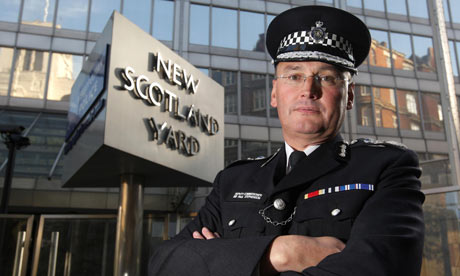 Sir Paul Stephenson, the Metropolitan Police Commissioner, has reduced operational use of the powers, starting in April 2009. From January to March that year there were 61,954 stop and searches, from April to June 36,060 took place, and from July to September just 29,396 were carried out.