|
 By Pinaki Roy in Dhaka By Pinaki Roy in Dhaka
The Sundarbans tiger swallowed Sarbanu Khatun’s husband as he went to the world's largest mangrove forest to collect honey as a means of livelihood.
Sarbanu was left unfed and homeless with four children, virtually living on the embankment by the river. She lost his agricultural land to shrimp breeders.
Sarbanu recently came to Dhaka from Satkhira, a coastal district 330km southwest of the capital.
“I have three school-going children but they cannot attend school,” she said at the ‘Hearing of Climate Victims’ rally held in Dhaka on May 22nd.
The rally was organised by the Campaign for Sustainable Rural Livelihood (CSRL) to mark the first anniversary of Cyclone Aila hitting the Bangladeshi coastline on May 25th 2009.
Cyclone Aila claimed the lives of 190 people and 150,000 livestock, and affected nearly four million more people through damage to 600,000 houses and ruined crops on 323,454 acres of land, according to an official record of the food and disaster management ministry.
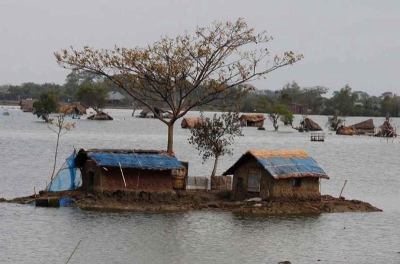
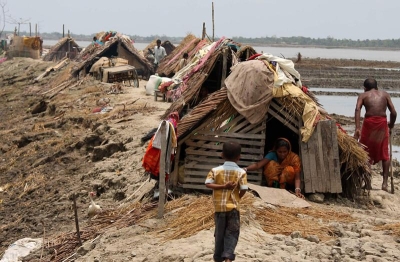 One year on, around 200,000 climate victims like Sarbanu cannot go back to their homes as they are inundated beneath saline water, which entered through breaches in embankments. Instead they must live on the remaining parts of the embankments. One year on, around 200,000 climate victims like Sarbanu cannot go back to their homes as they are inundated beneath saline water, which entered through breaches in embankments. Instead they must live on the remaining parts of the embankments.
“I often get up at night, as my shelter is just at the edge of the damaged dam. It could go into the water anytime,” said Monowara, 30, who made a temporary shelter on the embankment a few days after the catastrophe.
People in the affected areas suffer from lack of food, shelter, medicine and drinking water. “We can not drink even ground water withdrawn by sallow pump as it has also become saline since the cyclone hit the area,” Monowara said.
Abdus Sabut, from Gabura Union of Satkhira where the cyclone hit hardest, said that high tides twice a day flood his house, while the shop he had was also washed away, reducing his income.
“There is also no work in the shrimp farms,” he said, while fishing in the river and catching crabs in the forest is very risky due to the threat from robbers.
The forest is also dangerous due to Bengal tigers, said Abdus. This month six people were attacked by the tigers, killing three of them as they entered the Sundarbans.
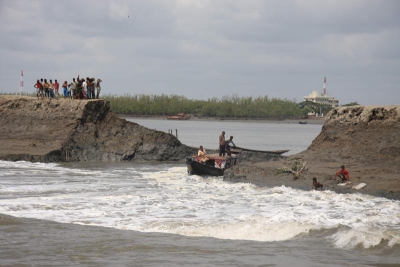 Now it is monsoon season, and the situation for Aila victims is worsening. Bangladesh officials delayed repairing the embankments due to the financial crisis and corruption in the Water Development Board. Now it is monsoon season, and the situation for Aila victims is worsening. Bangladesh officials delayed repairing the embankments due to the financial crisis and corruption in the Water Development Board.
Abdus said there was no possibility of repairing the embankment. “Only Allah knows what happens to us in this monsoon.”
According to Humanity Watch, an NGO working in the coastal region, around 100,000 affected people have migrated, with another 100,000 still living on the embankments.
Some 25,000 who could not find space on the embankment or manage the difficult livelihood returned home, said Hasan Mehedi of Humanity Watch.
“So far we have surveyed and found 1,552 families from Shayamnagar upazila have migrated from there. But we don’t know where they have gone,” said Zahid Hossain, an official working for the International Organisation of Migration (IOM).
Cyclone Aila hit just as the government was struggling to repair the damage from Cyclone Sidr, which killed around 5,000 people in six coastal districts. Aila struck just 18 months after Sidr.
Last July the food and disaster management ministry sought Tk110bn ($1.5bn) from donor countries and agencies for rehabilitation of the Aila victims, construction of embankments and cyclone centres, and to create employment opportunities in coastal areas.
“The international response in this regard has been very disappointing so far,” said an official at the ministry.
He said only one or two European countries promised to give $50 million. Japan already donated Tk1.14bn ($16m) to set up water treatment plants in the Aila-hit areas, he added.
The food and disaster management minister recently expressed deep frustration over the poor response of the international community to Bangladesh's pleas for international help in climate change adaptation.
Published Tuesday 25th May 2010 |

