|
The best and brightest young Sri Lankans intend to steer well clear of the country's politics - but there are some who cannot afford to. Nina de la Preugne reports.
The latest hits are playing and a stylish young crowd is dancing to the tunes in the sleek Amuseum nightclub in Colombo’s Galle Face Hotel.
The scene could be anywhere in Europe, and indeed many of the partygoers are Sri Lankans studying abroad, here on their summer holiday.
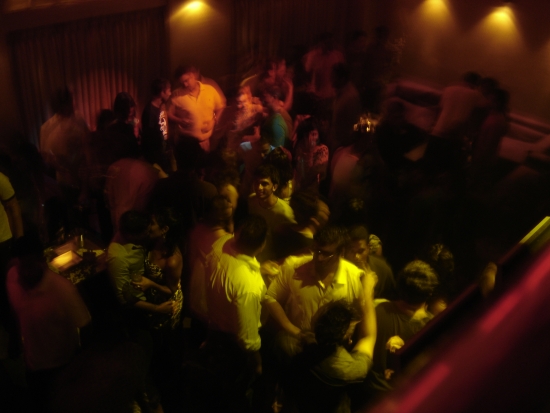
It is July 2009, a few months after government troops defeated the Liberation Tigers of Tamil Eelam, bringing an end to decades of civil war.
For the clubbers however, not much had changed. The rich Colombo bubble in which they evolved was never really affected by the conflict.
“I think it is great the government has put an end to this conflict, but I am not too much into politics to be honest,” said a 20-year-old girl, echoed by her friends.
But politics is never far away in Sri Lanka. With a population estimated at 20 million, social circles are very restricted, especially at the top.
Fast-forward to April 2010, and scratching beneath the surface reveals lives strongly influenced by the politics of the country.
“My parents expect me to help with the family company when I finish studying, and eventually take over from them. I know what this means in term of voicing my political opinions,” said 24-year-old Hashi in the Amuseum last week.
The recent presidential and legislative elections have strengthened a regime already wary of dissent. For the young and bright, the choice of remaining silent or putting their lives at risk is not particularly appealing.
“At first I wanted to come back to help,” said Tissya, 21, who studies at Cambridge. “But now I feel disillusioned, especially after the elections last week. I don’t know if there is much I can do here, the situation is more hopeless.”
Samath, 23, who used to work for a local NGO and hoped to enter politics after his degree, is reconsidering his plans. “Political freedom is on the decline, I would rather not go back now. I am studying International Politics and would like to work in the UK or Africa, in development. Not politics in Sri Lanka anyway, there is no point.”
Because of the war, Sri Lanka has lost some of its smartest minds to the West over the last 30 years, and the country’s underachievement in terms of development has been attributed to this large-scale brain drain.
To some, it was also one of the reasons for the length of the conflict, with reconciliation left in the hands of incompetent and nationalistic politicians.
None of the young people I spoke to could envisage a career in politics. The image of politics given by the different parties in the past, and especially during the last presidential and legislative elections, does not appeal to a generation familiar with professionally-run campaigns and free elections through their education abroad.
“Since last summer, things have changed and got worse. The way elections were handled, it is like a mafia”, said Samath.
But if political engagement is not an option, many find a way to play a role in their country’s future through civil society organisations.
Sri Lanka Unites, a youth organisation founded a year ago, tries promoting reconciliation by bringing together a new generation of leaders from all backgrounds and ethnicities.
“Our parents’ generation made a lot of mistakes that led to the war. Hopefully Sri Lanka Unites will become a group of moderate, informed people, capable of change and who will have to be listened to,” said Anushka Wijesinha, one of organisation’s founders.
Last August, Sri Lanka Unites brought together 400 young people from across the country to interact with each other during a five-day workshop, in order to break down their stereotypical ideas about the different ethnicities.
“It worked because people realised that they do have stereotypes about other communities,” said Anushka. “They were able to put a face on an ethnicity and it was no longer ‘the Tamils’, but ‘Dinesh my friend from Batticaloa.”
Deshal de Mel, a member of the organisation, said he was initially sceptical. “I thought change should come from the top down. But then I realised that it is a positive experience. You have to be the change agent.”
But in rural areas, the situation for the uneducated youth is a world apart.
In order to get a job, many of them have to get involved in politics and support the ruling party.
“Subsidies are not given to anyone who works for the opposition and jobs and promotions are offered to those working for the UPFA [the governing coalition]. There is a real victimisation of those who are not with the right side,” said Kabir Hashim, an opposition MP.
Sudesh, a 26-year-old Sinhalese man, explained that in order to be promoted in the local police station where he works, there is no other way than obeying orders coming from local MPs.
“Despite this, the main aspiration of the youth is to get a government job,” said Hashim. “It’s worrying. There is a culture of acceptance.”
|

