|
 By Emanuele Comi By Emanuele Comi
What would happen if the four million immigrants who live in Italy decided to not buy any products, make any phone calls, and not go to work for 24 hours?
This is what four women thought when they came up with the idea of a symbolic strike and public demonstrations all over the country to raise awareness of the value of immigration in Italy and fight discrimination against foreigners. Immigrants – as well as Italians – are demonstrating together today in at least 70 Italian cities. Milan will host a concert, Bologna a photographic exhibition, and in Varese a yellow bicycle built from recycled material will ride around the city.
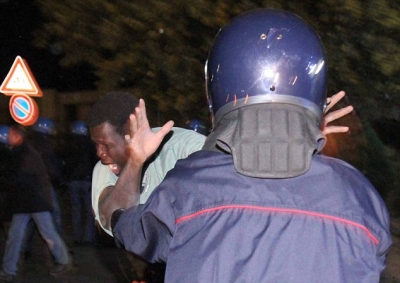
Immigrants’ feelings have been inflamed by recent episodes including riots in Milan following the murder of a young Egyptian by a gang of South Americans. Seasonal workers in Rosarno, Calabria, took their frustration onto the streets after young locals started shooting with air pistols near the awful shelters where these workers were living.
“I am convinced that this country is changing for the worst,” said Olawale Jelili Oladejo, 46, from Castelguelfo di Bologna, a town of about 4,000 people in Emilia Romagna. He entered the country from Nigeria to study 27 years ago and has worked for the chemical industry as a factory worker for more than 15 years. Although his wife and mother-of-two, Simisola 'Ronke Oladejo, has been living with him in Italy for nearly 20 years, has a nursing degree from an Italian university and works part time as a nurse in a rehabilitation centre, she still hasn’t obtained Italian citizenship due to bureaucratic problems.
Their daughters, aged 11 and 8, have received occasional insults at school from their Italian peers, such as “go back to the jungle”. At first reluctant about the idea of leaving the place where they were raised and have friends, the girls “would now be willing to leave the country for another place in Europe”, said Olawale.
According to a 2009 report by ISTAT, the Italian office of statistics, there are just over 4.2 million immigrants in Italy, 7.1 percent of the overall population. Two million immigrant workers contributed 10 percent of the country’s GDP last year, according to the 2009 Caritas-Migrantes report on immigration. They contributed seven billion Euros towards pensions last year, while just a few thousand of them are retired – whereas one in five Italians are now retired and benefit from the system.
But Olawale argues that their job is not appreciated by the Italian authorities: “They highlight only the negative elements of the community, like criminality. I want to remind the Italians that they were the ones who exported organised crime overseas. The institutions see immigrants like oranges to squeeze.”
Stefania Ragusa, 42, the president of the 1st March demonstration’s national coordination committee, is a journalist for Glamour and freelancer for several publications close to immigrant issues. She is one of the four founders of the movement. “We elaborated an agreed political line of the movement, but we are functioning mainly as a hub for the movement which is entirely grassroots,” she said.
In fact, the 1st March movement relies on at least 20 local committees created by volunteers with the help of the social network Facebook. More than 33,000 people have joined social groups related to the event.
Although internet use is not widespread among immigrants in Italy, it has helped spread the message among immigrant groups around the country. “We were aware that immigrants are often not familiar with the web, but it would have been mad not using the technologies available these days,” said Ragusa.
The movement is based on three points: immigration should be seen as valuable and not a threat; in today’s multiracial Europe it is not possible to talk about locals and immigrants as separate entities; and every human right should apply to a society as a whole, not just to a part of it.
Strikes will only take place in industrial areas of the country where the presence of immigrant workers is conspicuous and there is an agreement with the trade unions, including the cities of Brescia, Trieste and Padova in the north and in Tuscany. However, other forms of strikes, such as buying nothing or consuming nothing, will continue throughout the day.
A recent investigation carried out by the research institute SWG on racism among young Italians, which was presented to the Italian Parliament, said that 63 per cent of young Italians aged 18 to 29 believe intolerance is growing in the country, while just eight percent of them think the situation is getting better. Moreover, 60 percent of them think that young people are the most responsible for episodes of discrimination against immigrants.
At the top of the list of hated people in the survey were Roma, Sintis, Romanians and Albanians, followed by Turks and Muslims.
Ragusa argues that to understand Italy as “a racist country” is not difficult: “In your daily life you can notice it straight away, through the comments and a general hostility of the people.
“On the bus, as well as in shops, people fear being robbed by immigrants and the seat beside a black person is always free.”
|


There is racism in Italy, this is true. But racism has its origins in fear of change and outright ignorance. Italy is a country which seems to have a pathological fear of change - I think this is partly because it is such a young nation, and as such is still evolving. Italian culture revolves around traditions, and things which threaten these traditions cause fear which, in turn, leads to racism. Ignorance places quite a part too.
Immigrants who tend to stick to ways of their old nations and avoid integration do not do themselves any favours, but some effort does need to be made to help people fit into Italian society. Cultures can learn a lot from each other - I've learnt things from living in Italy, and can see my former country, the UK, in a slightly clearer light.
Things are changing a little in Italy and classrooms of mixed ethnicity should help new generations live together more harmoniously in the future.
Cuisine, sport, and schooling can all help us become used to a multi-cultural world. It would also be nice if the Roman Catholic church did more in Italy to promote the acceptance of other races and cultures.
I hope the immigrant strike in Italy draws attention to the issue of racism in Italy, but I think the road is still long.
Incidentally, the strike was covered quite extensively by the RAI 1 and 2 television news.
Note too that there is quite a lot of hypocrisy in Italy. Italians will complain about immigrants, but do not hesitate to take on immigrant labour.
All the best from Milan,
Alex