|
 By Nina de la Preugne By Nina de la Preugne
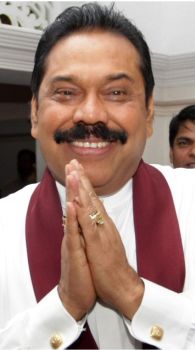
Sri Lanka’s ruling coalition has won a large majority in the country’s parliamentary elections – but fell short of the two-thirds majority President Mahinda Rajapaksa was hoping for.
Results released yesterday showed the United People’s Freedom Alliance (UPFA), Rajapaksa’s coalition, obtained 59 percent of votes across the country, securing 117 seats so far.
Complete results were not available as election violence and disruption prompted the Election Commissioner to request re-votes in several districts.
“The reported violence during the elections jeopardise the legitimacy of the results”, said DM Dissanayake of the Centre for Monitoring Election Violence (CMEV).
CMEV reported incidents in Nawalapityia, where polling agents were threatened, and in Trincomalee, where Tamil voters were intimidated and stopped from voting by UPFA supporters.
The two-thirds target
Rajapaksa dissolved parliament shortly after his re-election as president in January, in order to consolidate his government’s mandate and obtain a two-thirds majority.
A two-thirds majority would allow Rajapaksa to amend the country’s constitution and thus potentially enable him to run for a third term in 2017. However, given the recent results it appears the UPFA will fall short of its target by a few seats.
“We may fall short of 12-13 seats to get two-thirds, but that will not be a challenge for us,” UPFA spokesman Dullas Alahapperuma told The Times.
Without the two thirds majority, the government will be faced with two choices if it wants to amend the constitution – either buy off opposition MPs, or work together with the opposition on progressive amendments.
“If the government wish to change the constitution, it should do that together with the opposition. The constitution should be a consensual document. Otherwise those changes will be resented,” warned political analyst Jehan Perera.
The Tamil question
Amending the constitution in order to give minorities a significant role in politics is necessary to settle the conflict with the Tamil minority, analysts say. The creation of a second legislative chamber is one of the solutions suggested by Tamil politicians.
Tamil voters in Jaffna and other areas in the North and the East voted for moderate parties willing to collaborate with the government, instead of hardline Tamil nationalist parties.
This apparent readiness to find a middle ground through political dialogue will have to be followed up by the government which has so far expressed little interest in making concessions to ethnic minority groups.
Issues raised by the Tamil population in particular have not been addressed, despite the end of the war with the separatist Tamil Tigers a year ago.
“If these constitutional changes are not made, it will mean the minorities problem will not be resolved and will result in a probably renewed conflict in the future”, said Sanja Hattotuwa from the Centre for Policy Alternatives, an independent think tank in Colombo.
“The government is in a very unique position; it is the first post-war government. I hope that they will use this for the betterment of the country and not for the betterment of one family”, he added, unconvinced.
Rajapaksa has regularly been accused of nepotism because he appointed his brother Gotabhaya to the ministry of defence, while several members of his family are MPs.
His son Namal was elected as MP in the president’s native province, Hambantota, on Thursday, barely a year after graduating from City University in London.
Speaking to the Sri Lankan Guardian in May, Namal Rajapaksa expressed progressive ideas and an interest in making concessions to minorities.
“The government majority reduced its need to compromise with the opposition or the minorities. On the other hand, some people say that the government used a nationalist stance to win the elections and now that the elections are behind, it will act more liberally in order to solve the Tamil problem. One can only hope,” said Jehan Perera.
An irrelevant election?
The low turnout in Thursday’s election also generated concern from analysts who say the government must avoid overestimating the strength of its mandate.
“The low turnout means that the proportion of people who gave the government a clear, positive mandate represents only one third of the population. The government will need to keep this in mind when drafting policies,” said Perera.

Reasons for the low turnout have been the source of wide speculation in Colombo, with some attributing it to election fatigue, others to doubts over the election’s importance.
In Sri Lanka’s centralised presidential system, many people felt the parliamentary elections bore little importance for the future of the country.
Surawiira, a 29-year-old tuk-tuk driver, said he already gave his vote to the president and did not see the point of appointing the people who would work for him.
Moreover, the silence of the opposition during the campaign did not provide voters with a real alternative and failed to highlight the importance of checks and balance on the president’s power.
“It was a one party campaign. The opposition did not come out to campaign, mainly because of the intimidation exercised against it,” said CMEV’s Dissanayake.
Several organisations have alleged that the ruling coalition did not conduct the campaign fairly.
CMEV reports over 45 confirmed incidents of misuses of state property by the UPFA, such as the use of state vehicles for campaigning purposes.
“Sri Lankan people had their faith on the ballot, not on the bullet, most of the time. There was a low voters’ turnout. That itself tells a story. It shows that this faith is disturbed,” said Rajith Tennakoon, the director of the Campaign for Free and Fair Elections (CaFFE).
For many engaged members of civil society, hope seems to have shrunk in a matter of a few months.
The end of the war with the Tamil Tigers had opened a window that has been closed swiftly by the presidential and parliamentarian elections.
With a strong majority in parliament, Rajapaksa and his followers will have free rein for the next six years and will be able to shape the country’s future as they like.
“The next six years will be worse than the last five. There is a sense of desperation,” said an NGO director who asked to remain anonymous. |

